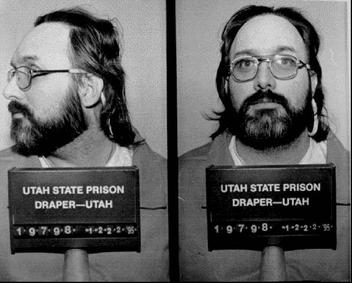
SUBJECT ON RECORD · EXECUTED BY RIFLE
John Albert Taylor
The second modern firing-squad execution in the United States, and the last one for almost thirty years. Taylor picked the rifle explicitly to embarrass Utah.
- Born
- June 6, 1959 · Ogden, Utah
- Died
- January 26, 1996 · Utah State Prison, Draper
- Age at death
- 36
- Convicted of
- First-degree child rape and aggravated murder
- Method
- Firing squad
- Facility
- Utah State Prison — warehouse execution chamber
VICTIMS ON RECORD
- V·01Charla Nicole King · 11 · Washington Terrace · June 23, 1989
§ 01
EARLY LIFE AND CRIMINAL HISTORY
Born in Ogden, Utah, in 1959, John Albert Taylor experienced a fractured upbringing characterized by parental instability, relocation to Colorado and Florida, and documented abuse. By his mid-teens, he had already engaged in violent criminal behavior, including a stabbing incident against his stepfather. His developmental years were marked by severe antisocial patterns; professional evaluations during his youth classified him as a remorseless pedophile, and he was mandated to participate in intensive sex-offender rehabilitation programs while residing in Florida.
His adult life in Florida was defined by repeated entanglements with the legal system. In the late 1970s and early 1980s, Taylor faced multiple felony convictions, including burglary, armed robbery, and weapons violations. Despite serving time in state correctional facilities and undergoing periods of parole, he continued to display predatory behavior toward minors. In 1989, he relocated to Utah, ostensibly to reconnect with his biological father and sisters, though this return preceded his most severe criminal acts by only a short duration.
§ 02
THE MURDER OF CHARLA NICOLE KING
On June 23, 1989, in Washington Terrace, Utah, eleven-year-old Charla Nicole King was found dead in her family's apartment. The victim, who had been preparing for her upcoming twelfth birthday, was discovered by her mother. The crime scene indicated a brutal encounter: the girl had been sexually assaulted and strangled using a telephone cord. Forensic evidence and subsequent investigation suggested the intruder had forced his way into the residence with the clear intent of sexual exploitation.
The discovery of the body prompted an immediate law enforcement response. The proximity of the crime to residences occupied by the suspect’s relatives provided investigators with significant leads. Within days of the homicide, familial cooperation and forensic analysis—specifically the identification of fingerprints on the telephone equipment used in the strangulation—linked the crime directly to Taylor.
§ 03
ADJUDICATION AND CONVICTION
Following his arrest in late June 1989, Taylor faced a bench trial presided over by District Judge David Roth. By waiving his right to a jury trial, Taylor opted for a judge-only proceeding. The prosecution’s case relied heavily on forensic identification and witness testimony placing him at the apartment complex. Despite his claims that he had entered the home solely to burglarize it while it was empty, the weight of physical evidence, combined with incriminating statements he allegedly made to other inmates regarding the murder, led to a conviction for first-degree child rape and first-degree murder.
During the sentencing phase, the court heard testimony regarding the defendant’s history of severe abuse and institutionalization. However, Judge Roth determined that the aggravating circumstances of the crime necessitated the imposition of a capital sentence. This conviction marked the first time in four decades that a Weber County court had delivered a sentence of death, underscoring the severity of the offense.
§ 04
APPEALS AND PROCEDURAL WAIVERS
The capital sentence triggered an automatic review by the Utah Supreme Court, which ultimately affirmed the conviction and the underlying death sentence. While defense counsel attempted various stay motions and appeals—including arguments over legal representation and the introduction of new life-without-parole legislation—Taylor eventually shifted his stance regarding the judicial process. In late 1995, citing poor physical health and a desire to expedite his fate, he discharged his attorneys and formally abandoned his appeals.
His decision to stop fighting the conviction removed the primary legal hurdles to his execution. Throughout this period, he maintained a defiant tone, insisting on his innocence while simultaneously rejecting further attempts at judicial delay. This shift moved the focus of the case from courtroom litigation to the mechanics of the impending execution at the state prison.
§ 05
SELECTION OF THE FIRING SQUAD
When prompted by the court to specify a method of execution, Taylor selected the firing squad, a choice that underscored his antagonistic relationship with the state. He expressed explicitly that his objective was to inconvenience and embarrass Utah officials, noting the logistical difficulties associated with organizing such an event. He further articulated a desire to avoid what he termed the indignity of the lethal injection process, characterizing it as a state of helplessness he wished to escape.
By choosing this method, Taylor aimed to force the state to execute him in a manner that was outdated and technically complex, reflecting his belief that the judicial process had been fundamentally unjust. This tactical choice made him a focal point for debate regarding the morality and practicality of the death penalty, ensuring that his final moments would serve as a public protest against the system that had convicted him.
§ 06
EXECUTION MECHANICS AND DEATH
In the early hours of January 26, 1996, at the Utah State Prison, the execution was carried out within a specially prepared warehouse facility. Five volunteer shooters were stationed behind a barrier, armed with identical rifles. To maintain the anonymity of the lethal participant, one of the rifles was loaded with a non-lethal wax projectile, ensuring that each shooter could believe their shot might not have been the fatal one. This measure was designed to distribute the psychological burden among the firing party.
Taylor was strapped to a chair, hooded, and positioned approximately 17 feet from the shooters. At the designated signal, the squad discharged their weapons simultaneously. Taylor was pronounced dead minutes later by medical staff. The event drew international media attention, with hundreds of journalists present to document the rare use of this execution method, while the victim's family and activists observed from their respective positions, marking the end of a long and contentious legal process.
§ 07
LEGISLATIVE AFTERMATH
The highly publicized nature of the execution served as a primary catalyst for legislative change within Utah. Immediately following the event, concerns regarding the propriety and societal cost of the firing squad gained significant traction in the state legislature. Lawmakers viewed the use of the firing squad not only as an operational burden but as an antiquated practice that drew unwanted focus to the state's penal system.
This sentiment culminated in the introduction and eventual passage of legislation—notably HB 180—which effectively abolished the option for condemned individuals to select the firing squad as their method of execution. This legislative reform was designed to modernize the state's death penalty protocols and prevent future inmates from using the execution process as a vehicle for public manipulation or political protest.

LAST WORDS
"I would like to say for my family and my friends — as the poem was written, 'Remember me, but let me go.'"
LAST MEAL
Large Ambassador pizza — thin crust, onions, mushrooms, hot peppers, sausage, pepperoni, ham, extra cheese — and a Coke. Shared with his uncle and a Catholic priest.